Fence: Perimeter → Budget
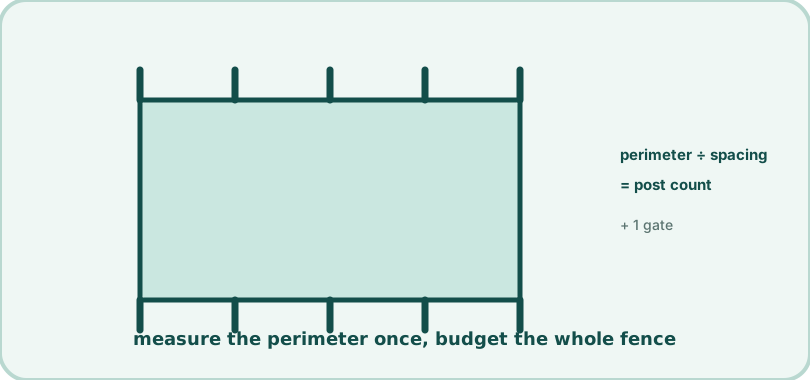
Fencing is priced per linear unit — posts per spacing, panels per width, concrete per hole. Everything hangs on one number: the perimeter of what you are enclosing.
Step 1 — the perimeter
Draw the boundary in the map tool and read the perimeter in meters or feet. Two honesty checks: property-line fences should follow the survey line, not the map's guess — confirm against your plat or survey before digging; and subtract house width plus any gaps where fencing makes no sense.
Step 2 — posts, panels, concrete
Budget notes the calculator leaves out, on purpose: corners and ends want heavier posts (count them: each corner is one), gates replace a bay with a frame plus hardware (one double gate ≈ one 3 m bay), and concrete runs about one 25 kg bag per hole for a 2 m post in most soils — soft soil doubles it.
What fencing actually costs
| Type | Cost feel | Watch for |
|---|---|---|
| Chain-link | $ — the budget line | Lean posts at corners; tension wire matters |
| Wood privacy | $$ — mid | Picket count explodes with width; stain is recurring |
| Vinyl | $$$ — high | Cracks in hard freezes; shop by thickness |
| Composite/horizontal | $$$$ — furniture pricing | Span limits force closer posts |
Rough per-meter material reality (2026): chain-link is the budget line, wood privacy sits mid, vinyl and composite sit high, and horizontal-slat styles price like furniture. Labor, when hired, is often comparable to materials — which is why a correct perimeter matters more than any price-per-meter: it is the one number in the quote you can independently verify with this tool.
Neighbors and lines
Shared boundary fences go smoother with a conversation before the post-hole digger, and many areas have formal rules — height limits, "good side" facing out, pool-barrier codes with exact clearances. A permit question takes one phone call; a moved fence takes a lawyer.
The per-unit cheat sheet
For store-counter arithmetic: one acre of full enclosure takes about 850 feet of single-wire fence; a 100-foot privacy run at six feet tall wants roughly 17 posts at 6-foot spacing and about 57 pickets at 6-inch width. The calculator above does this from your real perimeter — the cheat numbers exist so you can hear a nonsense quote in real time.
Frequently asked questions
How do I get the perimeter of my yard?
Draw the boundary in the map tool: the perimeter readout shows meters and feet live. For fenced lots, the existing fence line is usually visible in satellite imagery.
How far apart should fence posts be?
6-10 feet (1.8-3.0 m) depending on material: wood privacy fences sit at 6-8 ft, chain-link and wire at 8-10 ft, and heavier gates need dedicated posts regardless of spacing.
How much extra should I budget beyond materials?
A common planning number is materials ×1.3 once you include gravel/concrete for post holes, gate hardware, caps, and the fasteners that never come in the box. Labor, if hired, often lands near the materials cost again.