Lawn Size → What to Buy
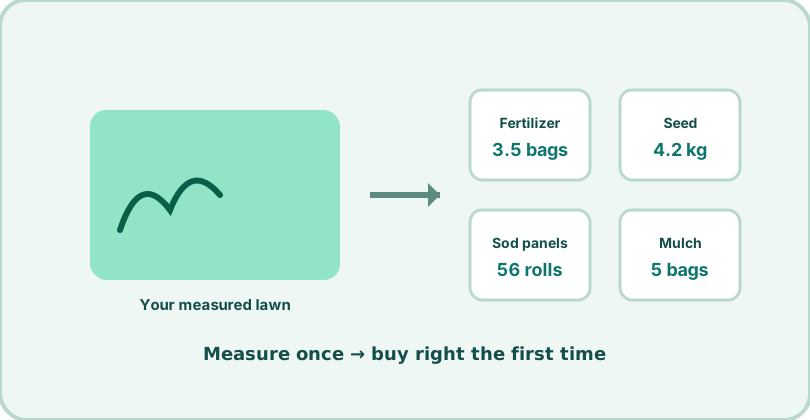
Lawn products are sold per coverage: fertilizer per m² or per 1,000 ft², seed per gram per m², sod per roll. Get the area right and every purchase below becomes a copy-paste number.
Step 1 — measure the grass (only the grass)
Draw your lawn in the map tool, tracing the actual green — the flower beds, paths and patio do not get fertilizer. The area readout in m² or ft² is your input for everything below.
Step 2 — turn area into quantities
The math behind each number, so you can swap in your own product's label: fertilizer assumes a 24 g/m² middle rate in 18 kg bags (your bag's label wins); seed assumes 35 g/m² for overseeding (new lawns run higher — up to 50 g/m²); sod assumes the standard 0.37 m² roll plus rounding up; mulch assumes 9 cm (3.5 in) depth in 56.6 L bags, covering about 6.3 m² each.
The assumptions, in one table
| Product | Rate assumed | Sold as |
|---|---|---|
| Fertilizer | 24 g/m² per feeding | 18 kg bag (≈750 m²) |
| Grass seed | 35 g/m² overseeding | by the kilogram |
| Sod | standard roll | 0.37 m² (4 sq ft) per roll |
| Mulch | 9 cm depth | 56.6 L bag (≈6.3 m²) |
Step 3 — buy with waste in mind
Rectangular lawns: add 5%. Lawns with curves, islands and tree rings: add 10%. Sod is perishable — it goes down within a day or two of delivery, so schedule the delivery for a day you can lay it, and order the whole amount at once (dyelot matters). The measurement guide covers tricky shapes: measure the bounding rectangle for a rough check, then trust the traced polygon.
Watering math, since you now know the area
A classic rule: 2.5 cm (1 inch) of water per week over your lawn equals about 10 L per m². At 1,000 m², that is 10,000 L — most sprinklers deliver 10-15 L per minute, so an hour of watering covers roughly a quarter of that lawn. Knowing your number turns "water it" into an actual plan. The same logic prices an irrigation zone: sprinkler heads are spaced by radius, but run times are set by area — the number you measured in sixty seconds is the one the whole watering schedule hangs on.
When the lawn is not one shape
Front lawn, back lawn, boulevard strip: trace each separately and save each with a name — the saved list keeps the numbers side by side, and products that differ by area (front gets fertilizer, back gets seed) stop being guessing games. Sum the saved areas mentally, or trace the whole property once for a total-budget view.
Frequently asked questions
How much fertilizer do I need per square meter?
Typical lawn fertilizer is applied at 20-30 grams per m² per feeding (check your bag's label rate). A standard 18 kg bag therefore covers roughly 600-900 m² — the calculator above uses 24 g/m² as a middle-rate estimate.
How do I convert my lawn area to sod rolls?
A standard sod roll covers about 0.37 m² (4 sq ft). Divide your area by 0.37 and add 5-10% for cutting waste around edges and obstacles.
Does the shape of the lawn matter?
For area-based products (fertilizer, seed, sod), no — only the total area matters. For edging and fence-style products, you need the perimeter, which the map tool also shows.